Read design guidance
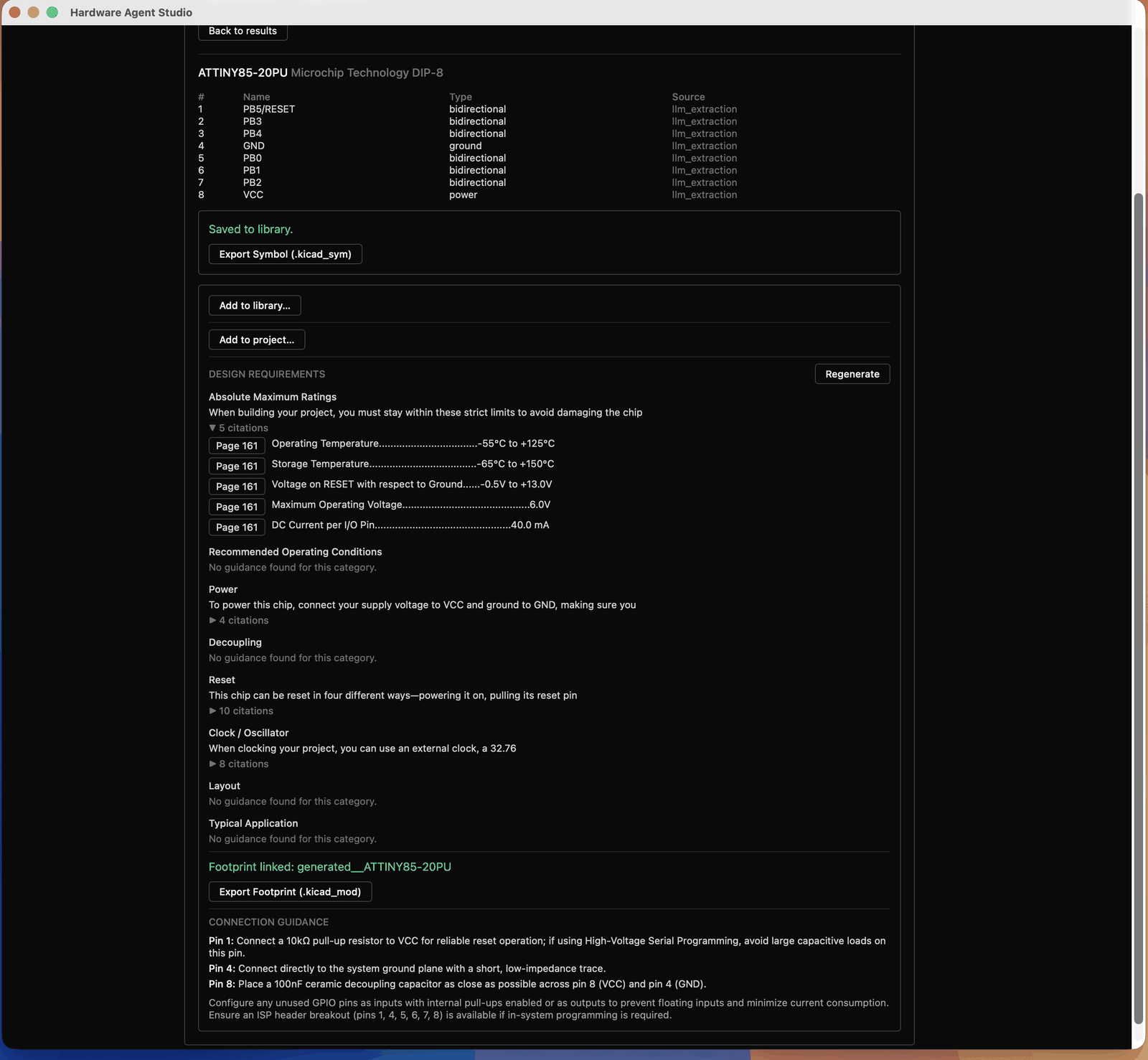
This is the feature the project exists for. On a saved part, click Generate design requirements.
What it does
Section titled “What it does”It does not hand a 230-page PDF to a model and hope. It runs two passes.
First it locates the relevant sections — finding the real numbered headings for each concern and narrowing to a handful of candidate pages. Then it extracts from those pages only, and every extracted item must quote text that genuinely appears on the page it claims.
An item whose quote cannot be found is discarded, not repaired. That is the contract that makes the rest trustworthy.
What you see
Section titled “What you see”Per concern — power, decoupling, reset, clock and oscillator, absolute maximum ratings, recommended operating conditions, layout, typical application — a short plain-language summary, with the underlying verbatim quotes collapsed beneath.
The summary is written strictly from those already-verified quotes. It never introduces a fact that is not in them, and it is never generated for a concern with no valid items.
Click a page citation and your cached copy of the datasheet opens at that page. That round trip — claim to source in about five seconds — is the point.
How to actually use it
Section titled “How to actually use it”Read the summary. For anything you are going to act on, open the citation. The summary is a reading aid; the datasheet page is the authority. The app is built so checking is cheap precisely because you should check.
Empty concerns are normal. Not every datasheet discusses every category, and an empty section means nothing citable was found — which is the honest answer.
Limitations worth knowing
Section titled “Limitations worth knowing”Guidance only appears if the datasheet says it in prose. Information that exists only inside a schematic diagram or an unlabelled table is not extracted today.
Citations resolve to a page, not a section. You get “page 31”, not “§7.2 of revision C”. There is no document-revision extractor yet, so if you regenerate against a newer datasheet the page numbers change with it.
Multi-variant datasheets are not scoped per variant. A document covering several part numbers may yield guidance that applies to a sibling.
A generated summary is not a review of your board. It tells you what the datasheet requires. Whether your design meets it is still your call.